When Founder of X Square Robot, Wang Qian, decided to leave a booming quantitative fund in the United States to start a robotics company in China, his colleagues thought he was “a little crazy.” But Wang, a Tsinghua graduate and one of the first scholars to apply attention mechanisms to neural networks, saw a future where general-purpose humanoid robots would no longer be science fiction.
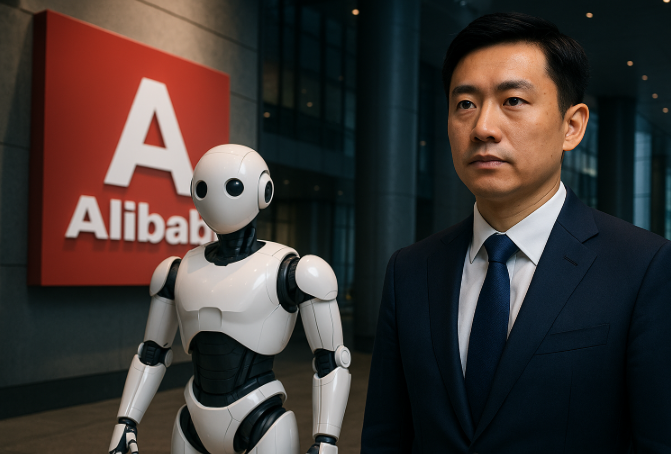
In December 2023, Wang founded Independent Variable Robots in Shenzhen, focusing on end-to-end unified vision-language-action (VLA) models aimed at achieving embodied intelligence – the kind of adaptive reasoning that enables machines to operate seamlessly in the physical world.
In less than two years, the company has completed eight funding rounds, including a ¥1 billion (≈$140 million USD) Series A+ co-led by Alibaba Cloud and Guoke Investment in September 2025 – marking Alibaba’s first foray into humanoid AI.
⚙️ Hardware and Software in Spiral Evolution
For Wang Qian, technological innovation is the company’s lifeblood. Nearly 90% of Independent Variable’s 200+ employees are engineers and researchers, forming one of China’s most R&D-focused robotics teams.
The company updates its AI model every two to three months, measuring progress by two benchmarks:
- Task complexity – the physical and interactive difficulty of an action (rigid vs. flexible object manipulation).
- Generalization ability – how well the robot adapts to new environments or tasks it hasn’t been trained on.
Through this method, the model evolved from picking up simple objects to handling complex flexible materials, such as folding clothes or zipping a zipper. By late 2024, the company achieved breakthroughs in multimodal reasoning and embodied “Chain of Thought” (CoT), enhancing the model’s ability to plan actions step by step.
In September 2025, the company open-sourced its embodied AI foundation model, WALL-OSS, attracting hundreds of developers on launch day and establishing an active open-source community – a rare move in China’s rapidly maturing robotics industry.
🧩 The Birth of Quantum 1 and Quantum 2
Initially, Independent Variable relied on supply-chain hardware for R&D. However, Wang’s team quickly realized that “software determines intelligence, but hardware determines reality.”
In 2024, the company began developing its own robot series. The Quantum 1 framework was completed that November, followed by the Quantum 2 project launched during Spring Festival 2025. Many engineers reportedly joined the company before receiving their bonuses, drawn by the chance to help define the next generation of humanoid robotics.
By August 2025, Quantum 2 debuted at the World Robot Conference (WRC), impressing audiences with smooth movements and self-developed exoskeleton technology. The humanoid performed interactive gestures – waving, forming heart symbols, and playing rock-paper-scissors – and demonstrated practical applications like 360° autonomous cleaning using mops and brushes.
🧠 Tackling Data Scarcity with Autonomous Collection
One of the biggest challenges facing the embodied intelligence sector is data collection. As Wang explains, robots’ interactions with the world – unlike human internet activity – leave no natural data trail.
To overcome this, Independent Variable has built a “data factory” for large-scale autonomous data generation. The company aims to expand into customer-facing environments to gather richer, more diverse datasets, improving model performance through refined data management and continuous self-learning loops.
💰 Financing Strategy: Small Steps, Rapid Progress
Despite its success, Wang acknowledges that China’s venture capital landscape has tightened since the pandemic, forcing startups to innovate in how they raise capital.
Ji Wei, founding partner of China Renaissance Capital, notes that Independent Variable’s approach – frequent, incremental “+round” fundraising – allows it to sustain momentum without waiting for large infusions.
“They don’t chase a perfect Series B,” Ji said. “They raise smaller rounds faster, deploy immediately, and keep iterating both the product and valuation.”
This agile financing mirrors the company’s technical philosophy: fast iteration, quick learning, continuous evolution.
🧭 From Capital Injection to Self-Sufficiency
As the hardware matured, Independent Variable began exploring commercialization more seriously. The Quantum 2 humanoid and its Dexterous Hand are expected to reach small-scale mass production by late 2025, expanding to larger runs in early 2026.
Wang Qian now views commercialization as essential:
“With hardware, the perspective changes – it’s not just a tech demo anymore; it’s a real product,” he said.
Still, he cautions against rushing into mass production. The company’s dual strategy splits the market into:
- Scientific research applications – offering full hardware and software solutions to research institutions.
- Industrial and service applications – targeting semi-open environments like logistics and light manufacturing.
Consumer applications remain the long-term goal, though Yang Qian admits affordability is still a challenge:
“No family will pay hundreds of thousands for an incomplete robot. But as capabilities rise and costs fall, the home market will open – likely within two to three years.”
Their shared vision is ambitious: a universal household robot capable of cleaning, organizing, and eventually cooking – an intelligent “digital helper” for everyday life.
🔮 The Bigger Picture
Independent Variable’s evolution from a two-person startup to a billion-yuan robotics powerhouse encapsulates the momentum of China’s embodied AI revolution.
By fusing VLA modeling, open-source collaboration, and integrated hardware design, the company is redefining what it means to build intelligent machines – and proving that innovation, not imitation, is China’s strongest export in robotics.
🔍 Keywords
Independent Variable Robots, Alibaba Cloud, embodied AI, VLA model, humanoid robotics, Quantum 2, WALL-OSS, China robotics, Wang Qian, Yang Qian, embodied intelligence, robotics funding, AI innovation, humanoid robot research, Shenzhen robotics